A two-week sleep diary
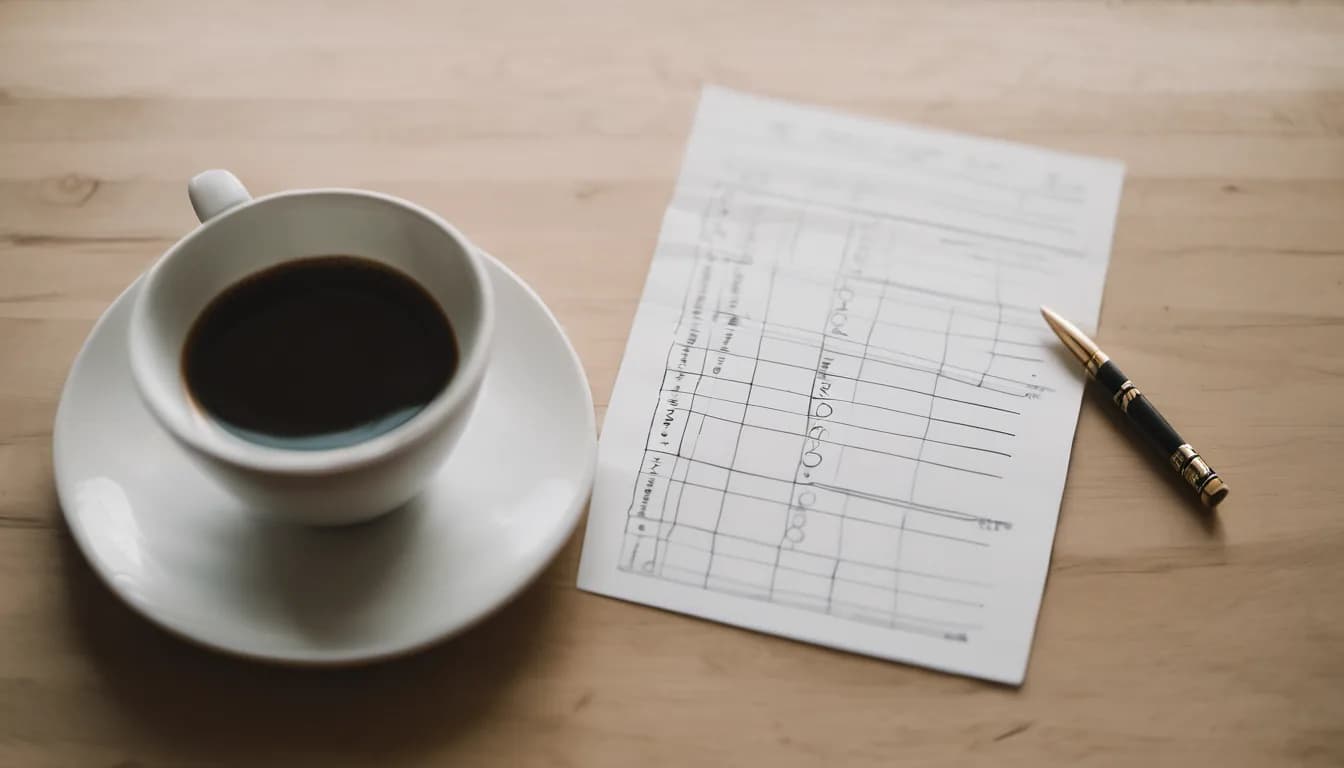
The sleep diary is the standard tool for assessing insomnia, more accurate than any questionnaire. A seven-field daily template and how to calculate sleep efficiency.
Key points
- A sleep diary kept for 1 to 2 weeks is standard practice for assessing insomnia. International guidelines do NOT use polysomnography to diagnose ordinary insomnia.
- Fill it in once, in the morning, within an hour of waking. Do not fill it in during the night and do not check the clock in order to be accurate.
- The most important number is not hours slept but SLEEP EFFICIENCY = hours asleep ÷ hours in bed. Below 85% is the marker that behavioural therapy targets.
- ⭐ The diary is also an intervention in itself: it starts to break up the habit of spending too long in bed, which is one of the mechanisms keeping insomnia going.
Seven fields to fill in each morning
| Field | What to record | Why it is needed |
|---|---|---|
| 1. Time into bed | When you lay down intending to sleep | With field 5, gives total time in bed |
| 2. Lights-out time | When you actually stopped reading or using your phone | The gap between fields 1 and 2 shows the bed being used for something else |
| 3. How long until you fell asleep | An estimate. Do NOT check the clock | Over 30 minutes is the marker for trouble falling asleep |
| 4. Number of awakenings and total time awake | An estimate | Separates trouble falling asleep from trouble staying asleep |
| 5. Final wake time and time out of bed | Two separate points | The gap between them is usually the easiest part to cut |
| 6. Sleep quality | A self-rated scale of 1 to 5 | The distress criterion, which the diagnosis needs |
| 7. Medication, coffee, alcohol, exercise, daytime sleep | Yes or no, and when | Finds maintaining factors that patients usually do not notice themselves |
Why you must not check the clock
It sounds like a detail, but this is one of the most effective pieces of advice there is. Checking the clock in the night does two things at once: it gives the brain a number to worry about, and it starts the calculation of "how many hours left before I have to get up". Both raise arousal, which makes getting back to sleep harder. Your morning estimate, inaccurate as it is, remains good enough for treatment purposes, and more importantly it does no harm.
How to read the diary after two weeks
- Calculate sleep efficiency for each night: hours asleep divided by hours in bed, times 100.
- Take the average over the 14 nights. Below 85% is the marker for behavioural intervention.
- Look for the pattern: mostly trouble falling asleep, mostly waking in the night, or waking too early? The three are handled differently.
- Look at field 7 on the worst nights: coffee after midday, evening alcohol, a long daytime sleep, or hard exercise close to bedtime usually show up here.
- Compare weekdays with the weekend. A difference of more than 2 hours suggests a circadian rhythm problem rather than insomnia.
About the copyright of this questionnaire
The diary template on this page was written by the clinic. It is not the Consensus Sleep Diary, which has its own terms of use. The seven fields below are the minimum any sleep diary needs in order to calculate sleep efficiency.
Frequently asked questions
- I kept the diary for 3 days then forgot. Do I need to start again?
- No. Carry on, and note the days you missed. A diary with gaps is still far more useful than recalling from memory. People estimate their own sleep very poorly, in both directions.
- My smartwatch already records my sleep. Can I use that instead?
- Use it for reference, but not instead. Consumer devices infer sleep stages from heart rate and movement, and they are usually least accurate in exactly the people who have insomnia: lying still without sleeping is very easily read as sleeping. Tracking sleep data too closely can also raise anxiety about sleep, which makes the problem worse.
References
- Behavioral and psychological treatments for chronic insomnia disorder in adults: an AASM clinical practice guideline - American Academy of Sleep Medicine, 2021 · DOI 10.5664/jcsm.8986
- The Consensus Sleep Diary: Standardizing Prospective Sleep Self-Monitoring - Sleep, 2012
- Clinical Guideline for the Evaluation and Management of Chronic Insomnia in Adults - American Academy of Sleep Medicine, 2008 · DOI 10.5664/jcsm.27286